This week’s updates point to a quiet but important shift in how Google surfaces and evaluates content — especially beyond traditional search results. With the rollout of the first-ever Discover Core Update, Google is signaling that Discover is no longer just an add-on feed, but a system with its own evolving quality standards. Combined with new insights into crawling challenges and Google’s framing of AI search as an expansion rather than a replacement, this week’s news offers a clearer look at where visibility and discovery are heading.
Google has officially launched the February 2026 Discover Core Update, marking the first core algorithm change focused solely on Google Discover — the personalized content feed that users see in the Google app and on mobile devices. This update kicked off on February 5, 2026 and is currently rolling out to English-language users in the United States, with plans to expand globally over the coming weeks.
What Is a Discover Core Update?
Unlike traditional Search core updates that broadly affect organic ranking signals for query results, this update is tailored specifically to Discover’s recommendation systems — the machine-learning systems that decide which content to show each user without an explicit search query.
Google describes core updates as significant algorithmic improvements designed to better surface quality content. Core updates don’t penalize websites but rather reassess how content quality, relevance, and user value are interpreted across systems.
Key Aims of the Update
Industry reporting and expert commentary suggest the February 2026 Discover Core Update centers on three major priorities:
This focus aligns with broader quality signals like E-E-A-T (Experience, Expertise, Authoritativeness, and Trustworthiness) already emphasized in Search quality documentation — suggesting Discover is increasingly governed by similar foundational criteria.
Why This Matters
The Discover feed can be a significant source of referral traffic for publishers, especially for news and timely content. A dedicated core update signals that Google considers Discover a distinct and strategically important platform — not just an offshoot of Search.
Because the update is Discover-specific, ranking changes here may not directly correlate with traditional Search visibility, meaning sites can see fluctuations in Discover traffic independent of Search performance.
What Publishers and SEOs Should Watch
Even in its early rollout phase, this update highlights several key takeaways for content teams:
The rollout is expected to take up to two weeks in the U.S. before expanding globally, so publishers with significant Discover traffic should monitor Discovery reports in Search Console and analytics closely over the coming days.
In a recent Search Off the Record episode, Google’s Martin Splitt and Gary Illyes walked through the 2025 Year-End crawling report, highlighting the biggest obstacles Googlebot faced last year. What they describe isn’t abstract SEO theory — it’s real-world crawling behavior that impacts how efficiently Google can discover and index content across the web.
Although the full episode goes into deep technical nuance, the core takeaways point to a handful of persistent issues that make crawling harder for Googlebot — and tougher for site owners who want consistent visibility.
What Google Found Was Tripping Up Crawlers
According to the data shared in the report and summarized by industry coverage:
These findings aren’t just numbers: they reflect real patterns where crawlers spend unnecessary time and resources, potentially slowing down discovery of your core pages and increasing server load.
Why Crawl Efficiency Still Matters
Even as Search evolves with AI and machine learning, crawl efficiency remains foundational. If Googlebot can’t reliably reach and interpret your site’s valuable content, that content may never get the attention it deserves in Search. Issues like runaway crawl loops, redundant parameters, and massive parameter-generated URL surfaces can waste bot resources and shake loose bandwidth you’d rather reserve for your strongest pages.
For SEOs and site owners, these insights reaffirm long-standing best practices:
In a year where crawling was anything but simple, these challenges highlight continued opportunities to make sites easier to crawl, more predictable to index, and more rewarding for users and search systems alike.
Google executives framed the current phase of AI-powered search as an “expansionary moment”, where artificial intelligence isn’t replacing traditional search activity but adding to it, driving richer, more engaged interactions across more modalities and query styles. This concept emerged from commentary tied to Alphabet’s latest earnings and public statements about how AI features are reshaping search behavior and usage patterns.
Executives like Sundar Pichai emphasized on Google’s Q4 2025 earnings call that AI-driven experiences are boosting overall search usage, rather than cannibalizing it. Pichai noted that as users engage with generative features, they tend to ask more questions and explore more deeply — a signal that AI features are expanding the volume and depth of interactions within Search.
This idea of expansion goes against early predictions that AI responses might reduce search volumes by answering queries directly without return visits. Instead, Google reports higher engagement and more complex query patterns, driven by longer sessions, increased follow-ups, and broader use of voice and image search — all infused with AI.
Contextually, this reflects Google’s ongoing integration of AI Overviews and AI Mode into Search. These features let users ask conversational questions and keep exploring related topics within the same interaction — effectively stretching search sessions instead of shrinking them.
Industry analysts note that richer AI interactions also influence monetization and revenue dynamics. AI-powered queries tend to be longer and more complex, opening up new surfaces for ads and potential commerce integrations like pilot “Direct Offers” in AI Mode.
Despite some concerns from publishers about zero-click results or reduced click-through to traditional links, executives — including Google’s Robby Stein — have explicitly described this as an expansion rather than contraction of how search functions, linking deeper AI engagement with increased overall activity.
In practical terms, “expansion” means:
For SEOs and publishers, this frame matters: it suggests that search visibility still exists within a richer engagement ecosystem, but the ways people interact with content are broadening. Visibility may now be measured not just in clicks, but in engagement depth, session length, and presence inside AI-guided pathways.
Taken together, these updates reinforce that search visibility is no longer confined to classic rankings alone. Discover is being refined with its own quality signals, crawl efficiency remains foundational, and AI-driven experiences are reshaping how users interact with information. For site owners, this means paying closer attention to how content is discovered, crawled, and recommended — not just how it ranks. Understanding these layers will be key as Google continues to diversify how content reaches users.
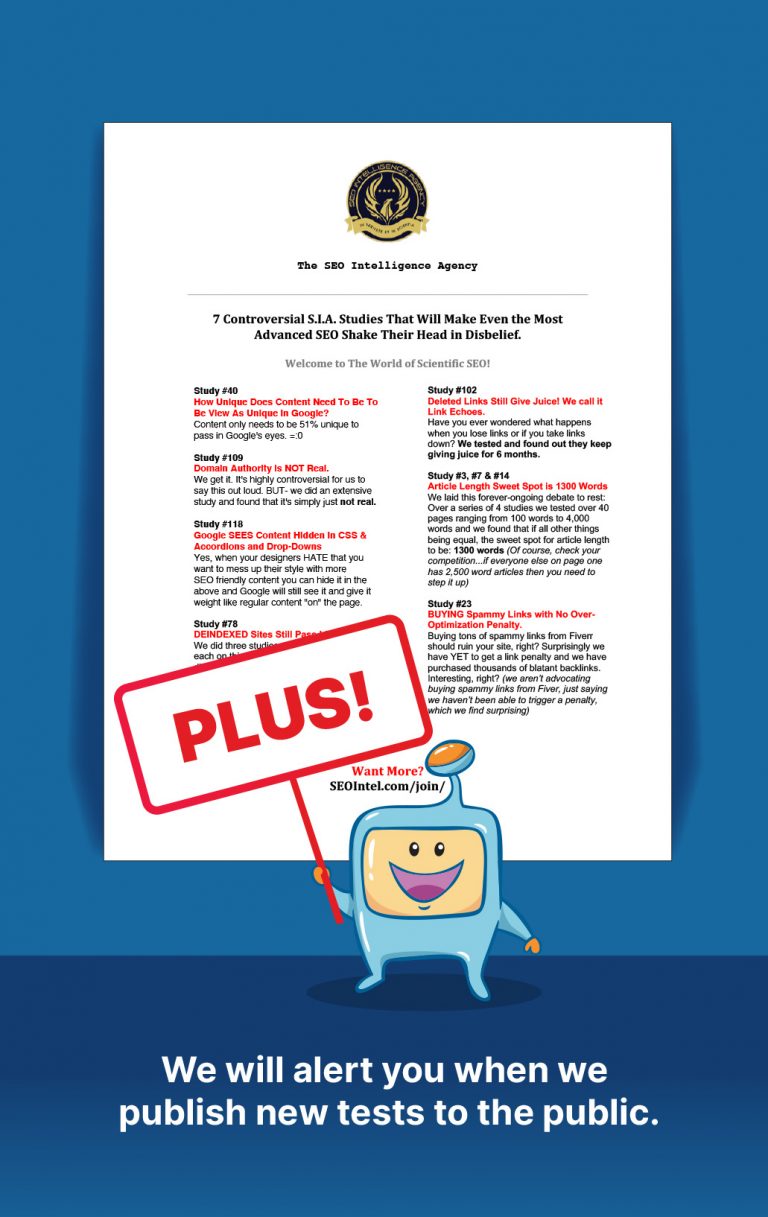
Get Our Most 7 Controversial S.I.A. Studies That Will Make Even the Most Advanced SEO Shake Their Head in Disbelief.
Plus we will alert you when we publish new tests to the public.
Obtenga nuestros 7 estudios S.I.A. más controvertidos que harán que incluso el SEO más avanzado sacuda la cabeza con incredulidad.
Además, le avisaremos cuando publiquemos nuevas pruebas al público.
Obtenez nos 7 études S.I.A. les plus controversées qui feront trembler la tête même les SEO les plus avancés d’incrédulité.
De plus, nous vous alerterons lorsque nous publierons de nouveaux tests au public.
Before you can receive free updates, link building strategies or SEO tips you need to confirm your email right now.
(It’s easy)
Just go to your inbox, open the confirmation email from the SIA, and click the link.
And that’s it!
PS: If you don’t see a confirmation email, please check your spam/junk or promotions folders. Sometimes the confirmation message ends up there by mistake.