The March 2026 Core Update is officially complete—and while the rollout lasted just under two weeks, the impact is still unfolding across industries.
This week’s biggest story isn’t just that the update finished—it’s what we’re now seeing in the aftermath: clear winners, sharp losses, and stronger signals around originality and value.
But that’s not the only shift happening.
From Sundar Pichai outlining Google’s long-term AI vision (and looming infrastructure constraints), to Dell’s real-world data showing that search still outperforms AI when it comes to revenue, a bigger picture is coming into focus:
Here’s everything you need to know from this week.
Google’s March 2026 core update has officially completed its rollout, marking the end of one of the most active and closely watched update periods in recent months.
The update started on March 27, 2026, and finished on April 8, 2026 at around 6:12 AM PDT, taking roughly 12 days and 4 hours to fully roll out—slightly faster than expected and shorter than some previous core updates.
Google described it, as usual, as a “regular update designed to better surface relevant, satisfying content”, without releasing any additional guidance or specific ranking factors.
A Fast Rollout—But Not a Quiet One
While the rollout duration was relatively short, the impact was anything but.
Across tracking tools, SEO communities, and analyst reports, this update:
This combination made March one of the most volatile periods in recent SEO history.
The Biggest Challenge: Attribution
One of the defining issues with this update is that it didn’t happen in isolation.
Within a span of about five weeks, Google rolled out:
What Sites Are Reporting After Completion
Now that the rollout is complete, clearer patterns are emerging from:
1. Significant Ranking Shifts (Winners and Losers)
Reports confirm:
Some site owners described sharp losses in visibility for key keywords, while others saw improved rankings across multiple pages.
2. “Information Gain” Is a Strong Emerging Pattern
One of the most discussed themes among analysts is information gain.
This refers to how much new, original value a page adds compared to what already exists.
Observed patterns:
While Google has not officially confirmed this, multiple analysts are seeing this trend consistently across datasets.
3. AI Content Isn’t Penalized—But Low-Value Content Is
Early observations suggest:
This aligns with Google’s ongoing emphasis on helpful, people-first content.
4. Continued Volatility Even After Completion
Even though the rollout is officially done, ranking fluctuations may:
Google itself advises waiting before making conclusions or changes.
What Google Says (And Doesn’t Say)
As with most core updates, Google’s official stance remains unchanged:
What’s notable this time:
This reinforces that core updates are:
broad system recalibrations—not targeted changes
What You Should Do Now
With the rollout complete, this is the most important phase—analysis.
Recommended next steps:
The Bigger Takeaway
The March 2026 core update may have been labeled “regular,” but its context makes it important.
This update reinforces a direction we’ve been seeing:
More than anything, this update highlights a shift:
It’s no longer enough to be accurate or comprehensive.
You need to be meaningfully different.
In Stripe’s interview with Sundar Pichai, the Google and Alphabet CEO lays out how he sees the company’s position in AI, where Search is headed, why Google is spending so aggressively on infrastructure, and what constraints could shape the next phase of the AI boom. The conversation covers a lot of ground, but the underlying message is consistent: Google does not see this as a defensive moment. It sees it as an expansionary one.
One of the more important parts of the interview is how Pichai reframes the familiar “Google invented Transformers but OpenAI productized them” narrative. His argument is that this history is often oversimplified. He says Transformers, TPUs, BERT, and MUM were not isolated research projects floating outside product reality. In his telling, they were built to solve concrete Google problems like translation, speech recognition at massive scale, and Search quality. He also argues that Google did use these advances in products quickly, especially in Search, even if it was not first to popularize the chatbot form factor the way ChatGPT did.
That matters because it connects to a larger point Pichai makes throughout the interview: Google believes it already built much of the stack needed for the AI era long before the current hype cycle fully arrived. He points to Google’s research depth, TPUs, infrastructure, multimodal model work, and broad product surface area as the foundation that let the company respond when the market shifted. In his view, Google may have trailed at moments on frontier LLM perception, but it was never missing the key ingredients.
Search is still at the center of that story. Pichai says Search will continue to evolve rather than disappear, and he explicitly describes a future where many informational queries become more agentic. Instead of a simple prompt-plus-links model, Search could become more of an “agent manager,” handling long-running tasks, asynchronous requests, and more complex workflows. That does not mean the product vanishes in 10 years, in his view. It means the interface and expectations around it keep changing, as they did in the shift from desktop to mobile.
He also makes it clear that Google does not see AI Search and Gemini as a zero-sum rivalry inside the company. His view is that both products can overlap in some ways and diverge in others, and that Google benefits from building across both. More broadly, he argues the AI market itself is not zero-sum right now. He compares this to earlier internet eras where multiple major platforms grew at once because the total value of the market expanded. That is an important framing, because it helps explain why Google appears willing to invest heavily across Search, Gemini, Cloud, YouTube, Waymo, robotics, and other areas at the same time.
A major practical theme in the interview is speed. Pichai says latency remains one of the defining traits of a great product, and he ties that not only to user experience but to technical excellence underneath. He explains that Google still treats milliseconds as meaningful, including through internal latency budgets for Search teams. He also highlights how Gemini’s speed on Google infrastructure is part of the product strategy, not an incidental benefit. The takeaway is that Google does not want to choose between capability and speed if it can avoid it; it wants to push both together.
The interview also becomes especially interesting when it shifts from product vision to physical constraints. Pichai says 2026 is fundamentally a supply-constrained year for AI. He describes limits around wafer starts, memory, permitting, power, construction speed, and even the number of electricians needed to build out capacity. Reuters separately reported Alphabet’s guidance that 2026 capital expenditures could reach $175 billion to $185 billion, which reinforces how serious Google is about scaling infrastructure despite those bottlenecks.
Memory stands out as one of the most important near-term constraints in the interview. Pichai says it is one of the most critical components right now, and he suggests that while supply should loosen over time, it cannot be dramatically expanded overnight. That matters because it means the next stage of AI progress is not just about model quality. It is also about who can secure and efficiently use scarce infrastructure. He also notes that these constraints can drive efficiency gains, forcing teams to build systems that are far more cost-effective than they would otherwise be.
Pichai’s broader economic view is notably bullish. He says the U.S. economy should become meaningfully larger because of AI, even if the effect is not always easy to capture with traditional GDP framing. At the same time, he is not presenting frictionless optimism. He points to real-world constraints around regulation, safety, security, infrastructure, and diffusion through society. Waymo is one example he gives: even if autonomous driving becomes safer than human driving, deployment still has to happen responsibly and at a pace society can absorb.
That balance between optimism and constraint also shows up in how he talks about AGI. Pichai pushes back on the idea that Google is somehow less serious than competitors about AGI or the long-term implications of frontier models. He frames those claims as mostly semantic or stylistic differences, noting that Google has been deeply invested in this trajectory for years and has increased spending accordingly. In his telling, Google is not less “AGI-pilled.” It is just a larger company with many products and a different public posture.
One of the more revealing sections of the interview is about how Google itself is changing internally. Pichai says some teams, especially within Google DeepMind and software engineering, have already shifted their workflows significantly around agents and internal AI tools, while the broader company is still in the process of diffusion. He suggests 2027 could be an important inflection point for non-engineering workflows, forecasting, and broader enterprise operations becoming much more agentic. That is a useful signal because it shows Google sees AI transformation not just as a consumer product issue, but as an internal operating model shift.
He also spends time on long-term bets, and this is where the interview gets especially ambitious. Pichai mentions areas like quantum computing, robotics, Wing drone delivery, Isomorphic Labs, and even early thinking around data centers in space. That does not mean all of these ideas are close to commercialization, but it does show how Google is trying to preserve its habit of making small early bets on potentially very large future platforms. He explicitly ties that approach back to lessons from Waymo and TPUs, where staying committed through long development cycles eventually paid off.
Waymo comes up several times, and Pichai’s comments there are especially notable. He says that, looking back, he would have liked to invest more capital in Waymo earlier once the maturity and safety curve justified it. He presents Waymo as a case where deeper technical evaluation and patience mattered more than outside sentiment. That is a meaningful clue to how Google thinks about capital allocation: make smaller early bets, judge them on technical progress, and scale investment when the underlying capability starts crossing critical thresholds.
Another important point is that Google’s capital allocation challenge has become much more compute-centric. Pichai says he now spends dedicated time each week thinking about compute allocation at a granular level because TPUs, GPUs, and ML infrastructure are scarce and strategic. That is a shift from the older tech-company pattern where most R&D planning centered primarily on headcount. In the AI era, talent still matters, but compute is now a first-class budgeting constraint.
At a human level, the interview also gives a useful glimpse into how Pichai stays close to products. He says he blocks time to dogfood internal versions, uses tools intensely in focused sessions, watches raw feedback, and increasingly relies on internal agents to summarize the best and worst reactions to launches. That might sound like a small detail, but it reinforces a central tension of the entire conversation: even a company as large as Google is trying to adapt itself to a world where AI is both the thing being built and the thing being used to manage the building process.
Key takeaways
Watch the full interview below:
Dell is emerging as one of the first major ecommerce players to publicly share real-world data on agentic AI traffic—and the results are far from hype-driven.
Based on insights from both Digital Commerce 360 and Search Engine Land, Dell’s experience reveals a critical truth:
Agentic AI is growing—but it’s not driving meaningful revenue (yet).
What Dell Is Actually Seeing So Far
Dell reports a clear increase in traffic coming from AI platforms like ChatGPT, Perplexity, and Claude. However, the impact remains limited.
This aligns with a broader industry pattern:
Agentic AI is visible in analytics, but not yet a major revenue driver.
The Key Insight: AI Drives Discovery—Not Purchases
One of the most important takeaways from Dell’s use case is this:
Agentic AI is currently strongest at discovery, not conversion
Dell expects agentic AI to behave more like:
This reinforces a key shift:
AI is entering the top of the funnel, not the bottom.
Why Search Still Matters More Than AI (For Now)
Despite all the attention on AI, Dell emphasized something very clear:
Search is still the most important driver of ecommerce success
Their internal view:
As Dell put it bluntly:
If users can’t find products easily, “nothing else matters”
This is a major signal for SEO and ecommerce teams:
Dell’s Strategy: Experimentation, Not Full Commitment
Dell is still in early-stage testing when it comes to agentic AI:
This cautious approach reflects uncertainty across the industry:
No clear “winning model” for agentic commerce yet
The Bigger Industry Context
Dell’s experience mirrors what we’re seeing more broadly:
Even industry forecasts suggest:
What This Means for SEO and Ecommerce
Dell’s use case highlights several important shifts:
1. AI Visibility Is Now a Traffic Source
2. Discovery Is Fragmenting
Users are no longer starting journeys only on Google or Amazon.
They are:
But they still:
complete purchases on traditional sites
3. Fundamentals Still Win
Despite new channels, the basics haven’t changed:
These remain more important than AI integrations—for now.
Key Takeaways
Bottom Line
Dell’s experience cuts through the hype:
Agentic AI isn’t replacing ecommerce—it’s reshaping how users arrive there.
For now, it’s an assistive layer, not a disruptive one.
But as capabilities improve, that balance could shift quickly—making this one of the most important trends to watch heading into 2026 and beyond.
This week’s updates highlight a critical turning point.
The March 2026 Core Update may be over—but its impact is still unfolding, and the signals are getting clearer: Google is rewarding depth, originality, and real value more than ever.
At the same time, while AI continues to reshape how users discover information, both Google’s own leadership and real-world data from companies like Dell point to the same conclusion:
The future isn’t about choosing between AI and search.
It’s about understanding how they work together—and where each one matters most.
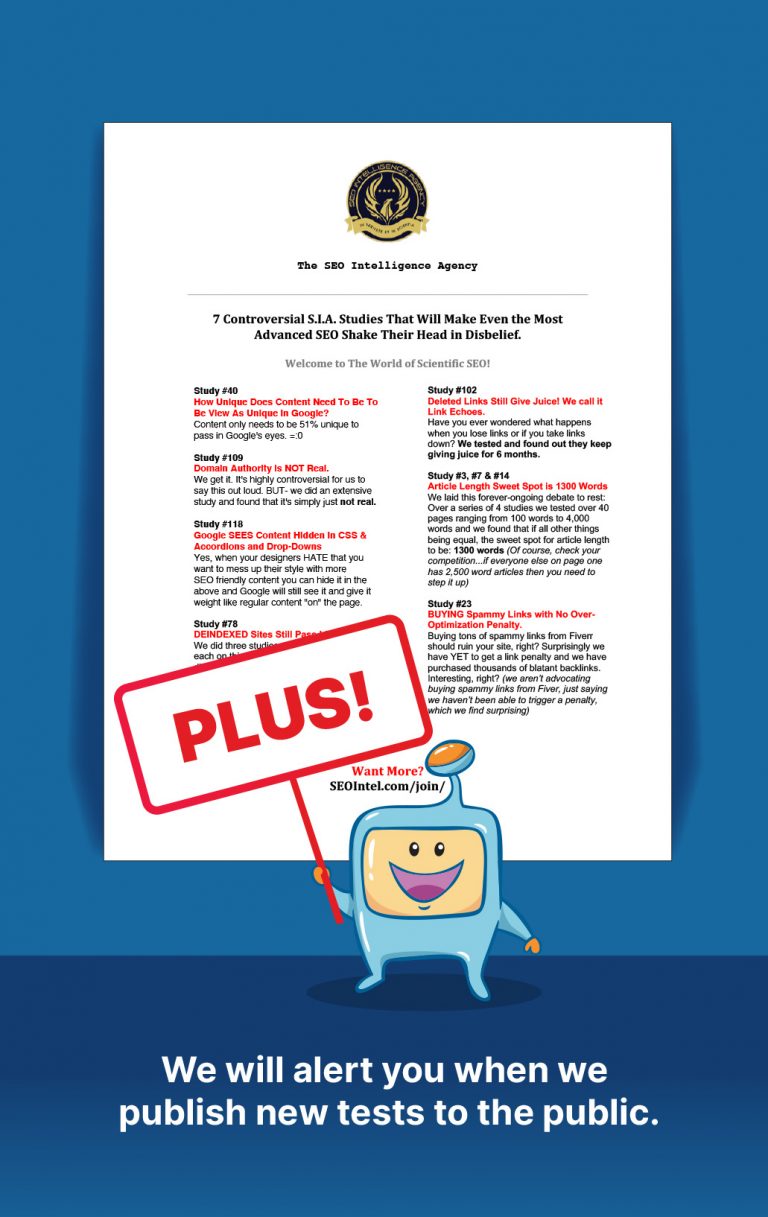
Get Our Most 7 Controversial S.I.A. Studies That Will Make Even the Most Advanced SEO Shake Their Head in Disbelief.
Plus we will alert you when we publish new tests to the public.
Obtenga nuestros 7 estudios S.I.A. más controvertidos que harán que incluso el SEO más avanzado sacuda la cabeza con incredulidad.
Además, le avisaremos cuando publiquemos nuevas pruebas al público.
Obtenez nos 7 études S.I.A. les plus controversées qui feront trembler la tête même les SEO les plus avancés d’incrédulité.
De plus, nous vous alerterons lorsque nous publierons de nouveaux tests au public.
Before you can receive free updates, link building strategies or SEO tips you need to confirm your email right now.
(It’s easy)
Just go to your inbox, open the confirmation email from the SIA, and click the link.

And that’s it!
PS: If you don’t see a confirmation email, please check your spam/junk or promotions folders. Sometimes the confirmation message ends up there by mistake.